
Why Texting Is the Right Channel for Churches
The bulletin insert gets left in the pew. The email blast reaches whoever opened it last week. The phone tree takes an hour to make it down the list. Text messaging cuts through all of it.
In 2026, roughly 80% of U.S. churches use SMS to reach their congregation, and it’s not hard to understand why: texts open at approximately 98% and most are read within three minutes of delivery (Pushpay, The Complete Church Texting Guide). No other communication channel in a ministry’s toolbox comes close to that combination of reach and speed.
But the case for church SMS isn’t just about open rates. It’s about timing. A church runs on people showing up — to Sunday service, to a small group, to a volunteer serve day, to a special event. The channel that gets a message into someone’s hand immediately is the one that moves people to action. That channel is text.
This guide is for pastors, church administrators, and volunteer coordinators who want to use SMS well — and do it in a way that’s compliant with the rules that apply to everyone, faith organizations included.
What Churches Actually Use SMS For
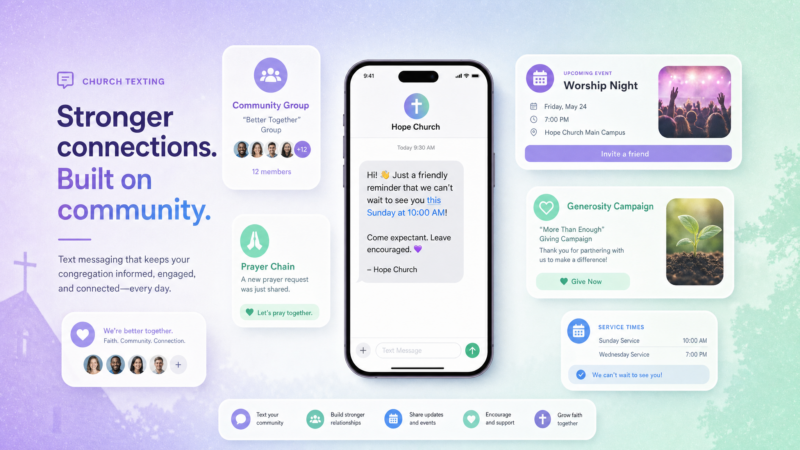
A church text messaging service covers a handful of core jobs, and doing those jobs well is where the real value lives. Here’s the full picture:
| Use Case | Who It Reaches | Why It Works |
|---|---|---|
| Service & event reminders | Full congregation | Lifts attendance by getting the reminder in front of people while it’s actionable |
| Giving campaigns | Congregation | Short link + one clear ask drives more action than another email |
| Prayer chains | Prayer team / opted-in list | Speed matters — a text reaches the team in seconds, not hours |
| Volunteer scheduling | Ministry teams | Confirms who’s showing up, fills gaps, reduces no-shows |
| New member welcome | Recent sign-ups | Sets the tone and creates a personal first impression |
| Emergency or weather alerts | Full list | Fast, reliable when email isn’t fast enough |
Each of these use cases is event-driven: something happens, a text goes out. The best church SMS programs automate the routine ones — like a Saturday-night service reminder that fires every week without anyone on staff manually scheduling it — and keep the human touches, like a personal welcome message to a new member, in the hands of a real person.
Service and Event Reminders
The most common use of church SMS is also the most impactful on attendance: a well-timed reminder before a service or event.
A Saturday evening reminder about Sunday service reduces the “I forgot” drop-off. A 24-hour notice before a midweek Bible study, a youth night, or a special speaker brings people who would have let it slip their calendar. A morning-of reminder to people who signed up for a serve day cuts no-shows significantly.
The key to a good reminder is simplicity:
- Name the church so the recipient knows who’s texting
- State the event and the time
- If there’s a location change or anything unusual, include it
- Keep it under 160 characters
- Let people reply if they need to
You can send to your full congregation list or filter to just the group that registered for a specific event. For large congregations, segmenting by campus or ministry area keeps messages relevant and reduces opt-outs from people who feel over-texted.
Image suggestion: ZeitBlast list segmentation view with church groups labeled (Youth Ministry, Volunteers, Full Congregation). Alt text: “ZeitBlast SMS list segmentation for church groups and ministry teams.”
Giving Campaigns via Text
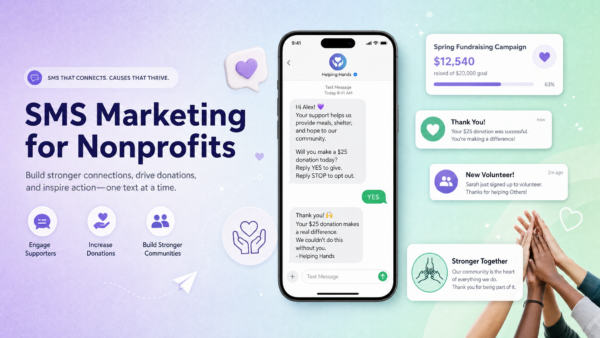
Giving by text has become one of the most effective ways churches and nonprofits drive end-of-year gifts, capital campaigns, and mission fund pushes. The math is simple: a short text with one clear link to a giving page reaches people where they already are, on the phone they’ll use to make the gift.
What makes a church giving text work:
- Connect it to the sermon. A text timed to a giving-focused sermon series lands with more emotional context than a random blast. “Pastor shared a vision for [mission] tonight — here’s the link to give: [link]”
- Include a real deadline or goal. “We’re $4,200 from our year-end goal with 5 days left” is more compelling than “please give.”
- One link, one ask. Don’t embed three different giving options or a link to an explainer page. Send them directly to the giving portal.
- Follow up once. A second text to non-responders is appropriate. A third is too many.
- Don’t blast everyone every campaign. Segment your list — people who have given before are your best audience for a giving ask.
Churches that add SMS to their giving campaigns consistently see higher response rates than email-only pushes, particularly among younger members.
Prayer Chains and Urgent Requests
The traditional prayer chain — one person calls the next, who calls the next — has an inherent problem: it’s only as fast as the slowest link. By the time an urgent prayer request makes its way through a 40-person chain, it’s taken an hour or more, and several people were unreachable.
SMS-based prayer chains solve this entirely. A single text to an opted-in prayer team list reaches all 40 people in seconds, simultaneously. The request is clear, timestamped, and in writing — no game of telephone distorting the details.
How to set it up:
- Create a separate opt-in list specifically for your prayer chain — “Text PRAY to [number] to join our prayer team alerts”
- Keep the list active and maintained — prune contacts who haven’t engaged in 6+ months
- When a prayer request comes in, send one clean text: who needs prayer, what’s happening, how to respond if they want to reach out
- Respect sensitivity — get permission from the person or family before broadcasting their situation
The prayer chain use case is one where having a dedicated segmented list makes an enormous difference. You don’t want to text your full congregation about a specific prayer request at midnight; you want to reach only the volunteer team that opted in for exactly that purpose.
Volunteer Scheduling and Coordination
Volunteers are the operational backbone of most churches. Greeters, nursery workers, worship team members, setup and teardown crews, serve-day volunteers — they all need the same thing: to know when they’re needed, confirmation that their commitment was received, and a quick way to flag if something comes up.
SMS handles all of this better than email:
- Weekly schedule texts: “Hi [Name], you’re on the Children’s Ministry team this Sunday at the 9am service. Reply YES to confirm.” Confirmations roll in automatically.
- Last-minute gaps: If someone cancels the night before, a quick text to a backup volunteer list fills the spot in minutes.
- Day-of reminders: A morning-of text to volunteers who haven’t confirmed reduces no-shows and gives the coordinator time to adjust.
- Post-serve thank-yous: A short text after a serve day acknowledging volunteers builds culture and keeps people engaged.
Automate the routine scheduling texts so staff aren’t manually sending the same messages every Saturday. Save the personal check-ins for the conversations that benefit from a human voice.
Example Church Text Scripts
Keep these short, name the church, give one clear ask, and personalize with merge fields where possible.
Sunday service reminder:
“Hi [Name], it’s Harvest Community Church. Reminder: Sunday services are at 9 & 11am tomorrow. We’d love to see you! Reply STOP to opt out.”
Event invite:
“[Name], our Family Night is this Friday at 6:30pm — free dinner, all ages welcome. RSVP here: [link]. Hope to see you!”
Year-end giving campaign:
“Hi [Name], we’re $3,800 from our Missions Fund goal with 4 days left. Every gift counts — give here: [link]. Thank you!”
Prayer chain alert:
“PRAYER REQUEST – Please pray for the Martinez family. [First name] is in surgery today. Reply if you’d like to reach out to the family.”
Volunteer confirmation:
“Hi [Name], you’re on the Welcome Team this Sunday at the 10am service. Reply YES to confirm or let us know if you can’t make it!”
New member welcome:
“Hi [Name], welcome to the Harvest Church family! We’re so glad you’re here. Your next step is our New Here lunch — details: [link].”
Emergency/weather alert:
“IMPORTANT – Due to weather, Sunday services are moved online. Join at: [link]. Stay safe, and we’ll see you soon!”
Compliance for Churches: Yes, It Applies to You
This is the piece most faith organizations miss, often until there’s a problem. Being a nonprofit or a faith-based organization does not exempt you from the rules that govern SMS marketing in the United States. The carriers and the FCC apply the same framework to a church as to a retail business.
What churches must do:
1. Get opt-in consent from every member on your list Having a phone number in your church directory is not the same as having permission to text it. You need affirmative opt-in — a signup form, a “text JOIN to [number]” keyword, a physical signup card at the welcome desk. The person must knowingly agree to receive texts from your church. Document it.
2. Register through 10DLC U.S. carriers require every organization sending A2P (application-to-person) texts at volume to register their brand and campaign through the 10DLC framework per CTIA guidelines. This applies to churches, nonprofits, and faith communities exactly the same as it applies to retailers. Unregistered texting gets filtered and doesn’t reach the inbox. See our guide: What is 10DLC?
3. Honor STOP instantly Every SMS program must support STOP opt-out, and any member who replies STOP must be suppressed immediately and permanently. This is both a legal requirement and the right thing to do.
4. Identify your organization in every message Don’t send anonymous texts. State the name of your church in every message so recipients know who’s reaching out.
5. Respect quiet hours The FCC baseline is 8 a.m.–8 p.m. in the recipient’s local time. A prayer chain alert at midnight is going to generate spam complaints and damage your sender reputation with the carriers.
None of this is prohibitive. A good SMS platform handles most of it automatically. But you do have to set it up correctly from the start — and buying a list or importing your full directory without consent is a liability, not a shortcut.
For the full legal picture, refer to the FCC’s telemarketing and texting rules and our TCPA compliance guide.
How ZeitBlast Serves Faith Communities
ZeitBlast is a compliance-first SMS platform that serves any organization that texts at volume — churches and faith communities included. Here’s what that looks like in practice:
Built-in compliance, not an afterthought. Automatic STOP/opt-out handling, quiet-hours enforcement, and ZeitBlast’s unlimited DNC (Do Not Call Registry) & litigator scrub are standard on every account. Your 10DLC campaign registration is guided and approved in as little as 48 hours.
Automated drip campaigns for every recurring communication. Saturday-night service reminders, weekly volunteer confirmations, thank-yous after events — set them up once and they run without anyone on staff manually scheduling each send.
AI Conversation Agent. When members reply with questions — “What time does the contemporary service start?” or “How do I sign up for the small group?” — ZeitBlast’s AI Conversation Agent handles the response intelligently, so your team isn’t managing individual replies around the clock.
Segmented lists for every ministry group. Separate lists for volunteers, the prayer team, young adults, parents of school-age kids — each group gets only the messages relevant to them. Relevance reduces opt-outs and keeps engagement high.
Two-way conversations. When a member replies to a giving campaign or an event invite, the response lands in ZeitBlast’s unified inbox where your team can pick it up and continue the conversation naturally.
Plans built for organizations of any size:
| Plan | Monthly Price | Texts Included |
|---|---|---|
| I’m Serious | $495/mo | 15,000 |
| Time to Scale | $795/mo | 30,000 |
| Market Dominator | $1,495/mo | 65,000 |
All plans include unlimited incoming replies, credit rollover, and live phone, chat & email support. No per-message hidden fees. See full details at ZeitBlast.com.
Image suggestion: ZeitBlast two-way conversation inbox showing a prayer chain reply thread. Alt text: “ZeitBlast SMS inbox for church two-way member conversations.”
FAQ
What is a church text messaging service? It’s an SMS platform that lets a church communicate with members and volunteers by text — service reminders, event invites, giving campaigns, prayer requests, and volunteer scheduling — from one place, with opt-out handling and carrier compliance built in.
Do churches need 10DLC registration to send texts? Yes. U.S. carriers require every organization sending A2P texts — including churches and nonprofits — to register through the 10DLC framework. There is no faith-based exemption. Registration is what gets your messages delivered instead of filtered as spam.
Is mass texting legal for churches? Yes, when done correctly. Members must explicitly opt in, STOP opt-outs must be honored immediately, and you must register through 10DLC like any other organization. Operating without those protections exposes your church to TCPA liability regardless of nonprofit status.
How do church members opt in to texts? Common methods include a physical signup card at services, an opt-in form on your website, a keyword opt-in (“text JOIN to [number]”), or a checkbox on a digital membership form. Keep a record of when and how each person opted in.
How many texts should a church send per month? Most church SMS programs average 4–8 messages per month to the full congregation — primarily reminders and announcements. Ministry-specific lists (prayer chain, volunteers) can receive more because the relevance is higher. Going over 8 general messages per month tends to drive opt-outs.
Can churches use SMS for fundraising? Yes. A short text with a clear ask and a direct link to a giving page is one of the most effective digital fundraising touchpoints available, particularly for capital campaigns, end-of-year giving, and mission fund pushes. Keep it to 1–2 texts per campaign and always connect the ask to something specific.
Ready to Reach Your Congregation Where They Actually Look?
ZeitBlast makes church SMS fast, compliant, and connected — from Sunday reminders to prayer chains to giving campaigns.
Request a Demo → zeitblast.com/contact