
Why Texting Is the Dealership’s Most Powerful Channel
A web lead fills out a form at 9 p.m. asking about a used pickup truck. By the time a salesperson calls at 10 the next morning, that person has already submitted the same inquiry to two other dealers, received a text from one of them 15 minutes after they filled out the form, and is now 30 minutes into a conversation about a test drive.
That’s the reality of automotive sales in 2026. Car buyers are online, they’re on their phones, and they move fast. The dealership that reaches them first gets the appointment.
SMS marketing for car dealerships solves the follow-up speed problem. A text reaches a shopper in seconds, gets read in minutes, and starts the conversation while they still remember exactly why they submitted that form. The same channel that wins the hot lead also books the oil change, sends the recall notice, fills the last-minute service slot, and asks for the five-star review that sells the next car.
Why texting outperforms other channels for dealerships:
- Speed on hot leads. The MIT / InsideSales Lead Response Management Study found that reaching a web lead within five minutes makes them roughly 21x more likely to qualify compared to a 30-minute wait. An automated text can fire the moment the form submits — even at 9 p.m. on a Saturday.
- People don’t answer unknown numbers. A call from a dealership’s main line goes straight to voicemail. A text gets read. For follow-up, that asymmetry matters enormously.
- Service revenue is the real profit center. Most fixed-operations managers will tell you the service lane is where the real margin lives, not the front lot. Text-based service reminders, appointment confirmations, and work-approval messages fill the bay without the manual overhead of calling every customer.
- Texts create a record. Unlike a phone conversation, a text thread creates a written record the CRM can capture — consent documented, conversations logged, follow-ups tracked.
Compliance First: Opt-In, 10DLC, and Quiet Hours
Before a single text goes out to a shopper or service customer, you need the compliance foundation in place. Sending without it isn’t just legally risky — unregistered texts don’t deliver reliably.
What dealerships must do:
Collect explicit opt-in consent. A web lead form with a pre-checked SMS box doesn’t count as consent under the TCPA. You need a clear, affirmative opt-in where the customer knowingly agrees to receive text messages from your dealership. Options include:
- A checkbox on the lead form with specific language (“I agree to receive marketing texts from [Dealership Name]”)
- A keyword opt-in (“Text UPDATES to [number] for inventory alerts”)
- A verbal confirmation during a service check-in, documented in the CRM
Register your 10DLC campaign. U.S. carriers filter unregistered A2P texting. 10DLC registration (brand + campaign), administered through The Campaign Registry, is the mechanism that gets your messages delivered instead of silently dropped. Every dealership sending at any volume needs to register. ZeitBlast handles this with approval in as little as 48 hours. Learn more: What is 10DLC?
Honor STOP immediately. Any customer who replies STOP must be suppressed from all future texts, permanently. This is non-negotiable and automated in any properly configured platform.
Respect quiet hours. The FCC baseline is 8 a.m.–8 p.m. in the recipient’s local time. A finance offer text at 7 a.m. generates spam complaints and damages your carrier sender reputation.
Scrub your list before every send. Run your contact list against DNC registries and litigator databases. TCPA class-action litigation has surged in recent years, and a single scrub failure can turn into a significant legal exposure.
For the full legal framework, see the FCC’s telemarketing rules and our TCPA compliance guide. Everything below applies to contacts who opted in.
The Seven Texts That Sell and Fill the Service Bay
Here’s the complete map of where dealership SMS earns its keep:
| Use Case | When It Fires | What It Does |
|---|---|---|
| New-lead follow-up | Within minutes of form submission | Beats competitors to first contact, books the test drive |
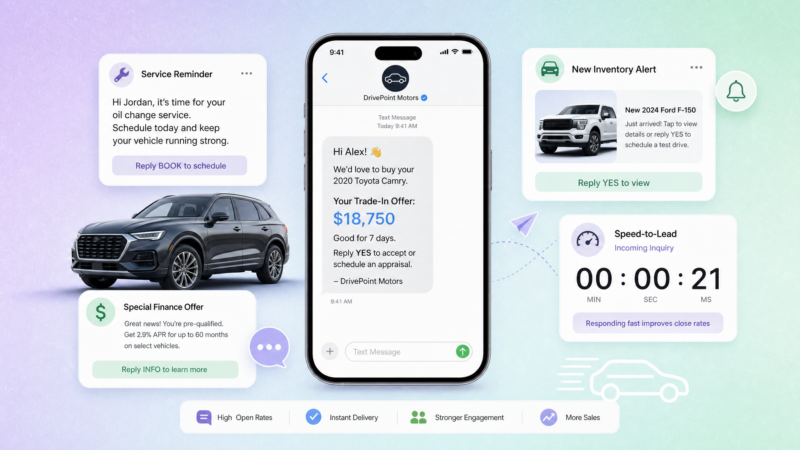
| Trade-in & finance offers | Equity window, lease maturity, or payoff date | Converts past buyers with a timely, relevant reason to return |
| Service & maintenance reminders | Mileage or time interval | Fills fixed-ops revenue automatically |
| Recall notices | VIN-matched campaign release | Gets the car in safely, builds long-term trust |
| Sales-to-service handoff | First service interval post-delivery | Converts a buyer into a recurring service customer |
| Review requests | Day after delivery or service | Builds the reputation that sells the next vehicle |
| Win-backs | 90+ days lapsed lead or service customer | Re-opens conversations that went cold |
New-Lead Follow-Up: The Five-Minute Window
This is the text that pays for the entire program.
A shopper submits a lead form — or walks the lot and hands over their number — and within minutes a text goes out. Short, personal, and with one clear ask. Not a wall of inventory, not a corporate template, not a “thanks for your inquiry” auto-reply. A human-sounding text from a specific salesperson.
Example scripts:
“Hi [Name], it’s Jake at River City Auto. Saw you’re looking at the 2024 F-150 — it just came in and it’s a great truck. Want to hold it for a look tonight or tomorrow? Just reply and we’ll set it up.”
“Hey [Name], Marcus here from Eastside Honda. Thanks for reaching out about the Accord. I’ve got a couple similar to what you described — can I send you the details?”
The reply rate on a text sent in the first five minutes is in a completely different category than a callback the next morning. Automation earns its value here: the moment a lead lands in your system — at any hour — the first text fires without a salesperson needing to be at their desk.
When the shopper replies, a real salesperson picks it up. The automation handles the speed; the human handles the conversation.
Trade-In and Finance Offers
Your past buyers are your best sales opportunity, and most dealerships underwork this list.
A customer who bought from you two or three years ago is potentially sitting in a vehicle with strong trade value, near a lease maturity date, or approaching payoff on a finance contract. That’s a real, specific reason to reach out — not a generic blast.
Segment the approach:
- Equity window: “Hi [Name], your [vehicle] has strong trade value right now and we’re short on pre-owned inventory. Want a quick number? No commitment — just reply YES.”
- Lease maturity (90 days out): “Hi [Name], your lease on the [vehicle] is coming up in about 90 days. Let’s talk options before the return — I can show you what’s available. Reply if you want to connect.”
- Finance payoff: “Hi [Name], you’re close to paying off your [vehicle]. A lot of customers in your position are surprised by what they can get into right now — want me to run some numbers?”
The key is specificity. A text that references the exact vehicle they own, with a real reason tied to their situation, converts. A generic “check out our current offers” blast to your whole customer list doesn’t.
Service Reminders and Appointment Management
Fixed operations is where the long-term dealership relationship is built — and where recurring revenue compounds over the years. Text-based service management is the most reliable way to fill that lane.
The full service-reminder flow:
- Mileage/time-based trigger: “Hi [Name], your [vehicle] is due for its [30K service / oil change / tire rotation]. We’ve got openings this week — what day works for you?”
- Appointment confirmation: “You’re confirmed for Thursday at 10am at [Dealership]. We’ll see you then! Reply CHANGE if you need to reschedule.”
- Day-before reminder: “Reminder: your [vehicle] service is tomorrow at 10am. Reply CONFIRM or let us know if something changed.”
- Work approval (if applicable): “Hi [Name], our tech found [issue] during the service. The repair is $[X] and will add about [time]. Reply APPROVE or CALL ME to discuss.”
- Vehicle ready: “Great news — your [vehicle] is ready for pickup! We close at 6pm today. See you soon.”
That sequence, fully automated, is worth more to fixed-ops revenue than almost any other change you can make to your service-lane process. It eliminates the no-show problem, keeps customers informed, reduces inbound “is my car ready?” calls, and captures approved work that would otherwise be delayed.
For a full breakdown of text-based scheduling, see our guide on SMS appointment scheduling.
Recall Notices
When a safety recall applies to a vehicle in your database, a text is the fastest, most reliable way to notify the owner.
The goal of a recall text is simple: get the car in safely and show the customer you’re looking out for them. This is not a sales text — it’s a trust-building communication that sets up a long-term relationship.
Script:
“Hi [Name], there’s an open safety recall on your [Year/Make/Model]. The repair is free and doesn’t take long. Reply and we’ll get it scheduled at a time that works for you. – [Dealership Name]”
Keep it plain. No promotional language. Clear explanation that it’s a safety item, that it’s free, and a simple call to action. The customer feels cared for; the dealership builds the goodwill that translates into future business.
Sales-to-Service Handoff
Most new-vehicle buyers never return to the selling dealership for service — a challenge the National Automobile Dealers Association (NADA) consistently highlights in its annual data reports — and that’s thousands of dollars in recurring revenue walking to the independent shop down the street.
The sales-to-service handoff text bridges that gap. It fires automatically at the first service interval — usually around 5,000–7,500 miles post-delivery — and it’s personal because the CRM knows exactly what they bought and when.
“Hi [Name], hope the [vehicle] is treating you well! You’re coming up on your first service interval. Want me to get you on the schedule? It’s quick — usually less than an hour. Just reply and I’ll take care of it.”
This single automation converts a one-time buyer into a service customer who associates the dealership with easy, proactive communication. Service customers who stay loyal over 5+ years are worth multiples of their original purchase in gross profit.
Review Requests
Your online reputation drives more vehicle sales than any advertising channel — J.D. Power consistently identifies online reviews as a top automotive purchase driver — and text-based review requests outperform email-based ones by a significant margin because the text arrives while the experience is still fresh.
Best timing: Send the review request the day after delivery or service — not same-day, not a week later.
“Thanks for your business, [Name]! If we took good care of you, a quick review would mean a lot to our team: [Google Review link]. We really appreciate it.”
Keep it short, keep it genuine, and include a direct Google Business Profile review link. Don’t ask for anything else in the same message. One ask, one link.
Win-Backs for Lapsed Leads and Service Customers
Not every lead closes on the first visit, and not every service customer comes back automatically. Win-backs are a structured way to re-open those conversations.
Lapsed lead (90+ days, no purchase):
“Hi [Name], it’s been a while since we talked about the [vehicle]. We’ve got fresh inventory with some great options right now — want me to pull a few that fit what you had in mind?”
Lapsed service customer (12+ months, no service visit):
“Hi [Name], it’s been a while since we’ve seen the [vehicle]. We’ve got openings this week and we’d love to earn your business back. Any day work for you?”
Keep win-back messages low-pressure. You’re re-opening a door, not making a hard sell. The goal is a reply — a reply starts a conversation, and a conversation creates a deal.
Putting It on Autopilot
A dealership has too many moving parts to send these texts manually. The value of SMS automation is that the right message fires at the right moment without anyone on staff remembering to do it.
How automation works in practice:
- Event-triggered sequences: Lead arrives → immediate follow-up text fires. Appointment booked → confirmation goes out. Car ready → notification sent.
- Tag-triggered sequences: Tag a contact “trade-in candidate” → sequence starts. Tag “no-show service” → recovery text fires the same afternoon.
- Time-interval triggers: 5,000 miles since delivery → sales-to-service handoff text. 90 days since last visit → win-back sequence begins.
- Human in the inbox for conversations: When a lead replies with questions, a real salesperson picks it up. Automation handles the timing; humans handle the conversation.
The result: no lead falls through the cracks at 9 p.m., no service customer waits days for a follow-up, and no manual reminder system depends on a salesperson remembering to check their CRM.
Image suggestion: ZeitBlast workflow builder showing a lead-arrival trigger with a 5-minute delay and first follow-up text. Alt text: “ZeitBlast automated dealership lead follow-up workflow with five-minute trigger.”
How ZeitBlast Powers Dealership SMS
ZeitBlast is built for the kind of volume, compliance, and automation that a dealership operation requires.
Speed-to-lead that works at any hour. ZeitBlast’s automated drip campaigns fire the moment a lead enters your system — from any source, at any time. The five-minute window doesn’t require anyone to be at their desk.
Unlimited DNC & Litigator Scrub. Every send is automatically checked against DNC registries and litigator databases before it goes out. For an industry dealing with a high volume of web leads, this protection isn’t optional — it’s essential.
AI Conversation Agent. When a lead replies “what’s the price on that?” or a service customer asks “how long does it take?”, ZeitBlast’s AI Conversation Agent handles the response intelligently, escalates when needed, and keeps the conversation moving around the clock.
10DLC in 48 hours. Your campaign registration is guided and approved in as little as 48 hours — the fastest in the industry. No long waits before your leads start getting texts.
CRM integration. ZeitBlast connects to Salesforce, HubSpot, and Zoho natively. For dealer-specific CRMs, Zapier and webhook integrations pass lead and customer events into your SMS flows automatically.
98% deliverability via direct carrier relationships. Every lead follow-up and service reminder reaches its destination — not a spam folder or carrier block.
Plans built for dealership volume:
| Plan | Monthly Price | Texts Included |
|---|---|---|
| I’m Serious | $495/mo | 15,000 |
| Time to Scale | $795/mo | 30,000 |
| Market Dominator | $1,495/mo | 65,000 |
All plans include unlimited incoming replies, credit rollover, and live phone, chat & email support. Learn more at ZeitBlast.com.
FAQ
Is SMS marketing legal for car dealerships? Yes, when done correctly. You need explicit opt-in consent from each contact, 10DLC registration so messages actually deliver, STOP opt-out handling, and adherence to quiet hours. You cannot text a purchased list or anyone who hasn’t consented. For the legal specifics, see our TCPA compliance guide and the FCC’s telemarketing rules.
How quickly should a dealership respond to a web lead? Immediately. The MIT/InsideSales Lead Response Management Study found that contacting a web lead within five minutes makes them roughly 21x more likely to qualify compared to a 30-minute response time. Automation lets the first text fire the moment the form is submitted, even after hours.
What should a car dealership text message say? Keep it personal and short. Identify yourself and the dealership, reference the specific vehicle or service, and end with one clear next step. A test-drive follow-up, a service reminder, and a trade-in offer each require a slightly different script — but they all follow the same structure: who you are → what you’re reaching out about → one ask.
How do dealerships use SMS for the service department? Service reminders triggered by mileage or time intervals, appointment confirmations and day-before reminders, work-approval texts during the service visit, vehicle-ready notifications, and post-service review requests. This sequence, automated, fills the service lane and reduces no-shows significantly.
Can I text customers about recalls? Yes, and you should. Recall notifications are high-value communications that build trust. Keep the message plain — safety item, free repair, easy scheduling — with no promotional content mixed in.
What happens when a customer replies STOP? ZeitBlast automatically and permanently suppresses that number from all future sends. No manual action required, and no way for a staff member to accidentally override it.
Start Filling the Lane and Closing More Leads
ZeitBlast gives dealerships the speed, automation, and compliance to turn every web lead and every service-due customer into a handled conversation.
Request a Demo → zeitblast.com/contact