
Why Speed Wins in Insurance — and Why SMS Is the Answer {#why-speed-wins}
Most insurance leads don’t go cold because your rates aren’t competitive. They go cold because someone else picked up the phone first.
Here’s the reality: a prospect fills out a quote form, and within minutes they’re getting calls from three different agents. The first one to have a real conversation typically wins — not the cheapest, not the most experienced. The fastest.
Phone calls go to voicemail. Emails sit unopened in a cluttered inbox. But text messages? According to CTIA, SMS open rates hover around 98%, and most texts are read within three minutes of receipt — compared to roughly 21% for email. That’s the window between winning a lead and losing one.
For insurance agents — whether you’re selling auto, life, home, health, or commercial lines — SMS marketing is the fastest legitimate way to start a conversation with a new prospect. And once you have a book of business, it’s how you keep clients from shopping around at renewal time.
This guide covers the full playbook: use cases, scripts, compliance rules, automation, and how to put it all together without burning your number or violating the TCPA.
The Core Use Cases That Move the Needle {#core-use-cases}
New Lead Follow-Up {#new-lead-follow-up}
The moment a prospect submits a quote request, the clock starts. Research consistently shows that response time is the single biggest predictor of conversion — leads contacted within five minutes are dramatically more likely to convert than those reached an hour later.
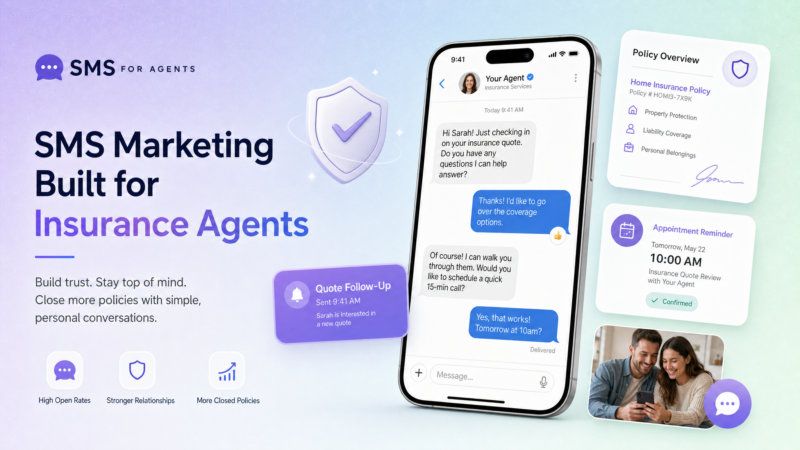
A text does what a phone call can’t: it lands instantly, doesn’t require the prospect to stop what they’re doing, and invites a low-pressure response. The goal of the first text isn’t to close — it’s to start a conversation.
A strong new-lead sequence looks like this:
- Message 1 (Day 0, within minutes): “Hi [First Name], it’s [Agent] with [Agency]. I saw your quote request come in — got a couple questions to make sure I build you the right coverage. Got 5 minutes to connect today?”
- Message 2 (Day 1, if no reply): “Still here when you’re ready, [First Name]. Happy to run the numbers at any time — just reply here or call me at [number].”
- Message 3 (Day 3): “Hi [First Name], rates have moved a bit this week. Want me to pull a fresh quote before it changes again?”
Three touchpoints, spaced out, non-pushy. This kind of drip sequence is where automated SMS platforms pay for themselves.
Appointment Booking and Reminders {#appointment-booking}
Once a prospect agrees to a conversation, getting them to actually show up is the next hurdle. No-shows cost you preparation time and kill momentum. A confirmation text when the appointment is set — followed by a reminder the day before — reduces no-shows dramatically.
Keep confirmation texts short: the time, how you’re meeting (call, video, in-person), and a clear way to reschedule.
Example confirmation: “You’re confirmed with [Agent] at [Agency] on Thursday at 2pm. We’ll connect via phone at [number]. Reply R to reschedule.”
Example day-before reminder: “Quick reminder: your insurance review is tomorrow at 2pm. Reply R if you need to move it.”
Policy Renewal Reminders {#policy-renewals}
Your existing clients are your most valuable asset — and they’re most vulnerable at renewal time. When a renewal notice lands in the mail or email, it becomes a shopping trigger. If you text them first, you control the narrative.
A well-timed renewal sequence:
- 30 days out: “Hi [First Name], your [policy type] renews on [date]. I reviewed your file and have a few thoughts — want to connect before then?”
- 7 days out: “Your renewal is coming up next week, [First Name]. Nothing to worry about, but I’d love to do a quick review and make sure your coverage still fits. Grab a few minutes here: [link]”
- Day of renewal: “Your policy renewed today, [First Name]. Thanks for trusting us another year. If anything changes on your end, I’m always a text away.”
This sequence turns a renewal from a retention risk into a touchpoint that deepens the relationship.
Win-Back Campaigns {#win-back-campaigns}
Former clients leave for price, convenience, or inertia — not necessarily because they found something dramatically better. A well-timed win-back text acknowledges the gap without being awkward.
Example: “Hi [First Name], it’s [Agent] with [Agency]. Rates have shifted a lot recently, and I can usually beat most renewals right now. Worth a 5-minute comparison? No pressure either way.”
The key is making it genuinely useful — tie it to a real market event (rate changes, new products, legislation) rather than just “we miss your business.”
Review and Referral Requests {#reviews-referrals}
Happy clients are your cheapest lead source. But most people won’t leave a review or send a referral unless you make it dead simple.
Send a review request within 24-48 hours of a policy binding or a positive interaction — the window when goodwill is highest.
Review request example: “Thanks for choosing [Agency], [First Name]! If you have 60 seconds, a quick Google review helps other families find us: [link]. We appreciate you.”
Referral request example: “Glad we got your coverage sorted, [First Name]. If you know anyone who could use a quote, send them our way — we’ll take good care of them.”
Insurance SMS Scripts You Can Use Today {#sms-scripts}
Copy these and customize with your agency name, merge fields, and booking links. Every message should identify who you are — that’s both a compliance requirement and a trust signal.
| Use Case | Script |
|---|---|
| First lead touch | “Hi {firstName}, this is {agent} with {agency}. You requested a quote online — I’d love to put numbers together for you. Got a few minutes today? Reply STOP to opt out.” |
| Day-2 follow-up | “Hey {firstName}, wanted to make sure I didn’t miss you. I can have your quote ready in about 10 minutes — just say the word. {agent}, {agency}” |
| Appointment confirm | “{firstName}, you’re all set with {agent} on {date} at {time}. Reply C to confirm or R to reschedule. {agency}” |
| Day-before reminder | “Quick reminder: your review with {agent} is tomorrow at {time}. See you then! Reply R to move it. {agency}” |
| Renewal 30-day | “Hi {firstName}, your {policyType} renews {renewalDate}. Mind if I do a quick coverage check before then? — {agent}, {agency}” |
| Win-back | “{firstName}, it’s {agent} at {agency}. Rates have shifted and I think I can beat your current premium. Worth a 5-min call? Reply STOP to opt out.” |
| Review request | “Thanks for choosing {agency}, {firstName}! A quick review helps other clients find us: {reviewLink}. Really appreciate it. — {agent}” |
TCPA and Compliance: What Every Agent Must Know {#compliance}
Insurance is a regulated industry, and SMS marketing adds its own layer of rules on top. Getting this wrong isn’t just a deliverability problem — it’s a legal one. Here’s what you must know:
1. Written consent is required for marketing texts.
Under the TCPA (Telephone Consumer Protection Act) — enforced by both the FCC and FTC — you need prior express written consent before sending marketing messages to any contact. A quote form with a visible, unchecked consent checkbox qualifies. A purchased lead list does not.
2. Identify yourself in every message.
Every text must include your name and agency. This protects you legally and builds trust with the recipient.
3. Include opt-out language.
Every message must include a clear way to stop receiving texts — typically “Reply STOP to opt out.” Honor opt-outs immediately and do not re-add opted-out numbers.
4. Respect quiet hours.
Under the TCPA, you cannot text before 8 a.m. or after 9 p.m. in the recipient’s local time zone. Some states have stricter rules (California, Florida, and others have their own regulations) — the NAIC maintains state-by-state insurance resources, and each state’s telecom laws can add additional restrictions if you operate across multiple states.
5. Don’t text purchased lists.
This one bears repeating. Purchasing a list of phone numbers and texting them without consent is a TCPA violation with significant liability exposure. Build your list from opt-in sources only: quote forms, website sign-ups, in-person opt-ins, and existing client relationships.
This is general information, not legal advice. Consult a licensed attorney for guidance specific to your situation.
For a deeper dive, see our guide on TCPA compliance for SMS marketing.
10DLC Registration for Insurance Agents {#10dlc}
If you’re sending business text messages from a standard 10-digit local number (not a toll-free or short code), you need to be registered under the A2P 10DLC framework. Carriers use this registration to vet business senders — unregistered messages get filtered or blocked.
Insurance is flagged as a higher-scrutiny industry by carriers, which means registration accuracy matters even more. Your business name, EIN, actual opt-in language, and campaign use case all get reviewed by The Campaign Registry.
The good news: once you’re registered and approved, your messages get delivered. The bad news: doing it wrong — submitting inaccurate information, using vague campaign descriptions, or listing fake opt-in methods — delays approval and can get your campaign rejected.
ZeitBlast provides 10DLC approval in as little as 48 hours with built-in compliance support to help you get it right the first time. For the full breakdown, see What is 10DLC?.
Automating Your Follow-Up Sequences {#automation}
Manually texting each new lead the moment their form comes in isn’t scalable — especially if you’re managing a book of hundreds of clients. Automation is what turns SMS from a task into a system.
Here’s how a fully automated insurance SMS workflow looks:
Lead comes in →
- Trigger: New lead added to CRM
- Message 1 fires immediately (day 0 intro text)
- If no reply in 24 hours → Message 2 fires (day 1 follow-up)
- If still no reply → Message 3 fires on day 3
- Lead replies → Conversation routed to agent inbox
- Appointment set → Confirmation text fires automatically
- 24 hours before appointment → Reminder text fires
- Policy binds → Review request fires 24 hours later
- 30 days before renewal → Renewal sequence begins
Every step runs automatically. You only step in when a lead or client actually responds — which is exactly what you should be doing.
ZeitBlast’s Automated Drip Campaigns handle this sequencing, including merge field personalization and automatic opt-out management. The AI Conversation Agent can handle initial replies, qualify the conversation based on your rules, and escalate to you when a lead is ready to talk.
How ZeitBlast Handles Insurance SMS {#zeitblast-features}
ZeitBlast is built for high-volume, compliance-first SMS lead generation — which maps directly to how insurance agents need to operate.
Here’s what’s included on every plan:
- 10DLC Approval in 48 Hours — Insurance is a higher-scrutiny category, and ZeitBlast’s registration process is built to get it right fast
- Automated Drip Campaigns — Build your entire lead follow-up, renewal, and win-back sequences once; they run on autopilot
- AI Conversation Agent — Handles initial replies, qualifies conversations based on your criteria, escalates hot leads
- Unlimited DNC & Litigator Scrub — Automatically screens your list against the Do Not Call registry and known litigators before every send
- Carrier-Safe Batching — Messages sent at carrier-approved rates to protect deliverability
- 98% Deliverability Rate — Your texts actually arrive
- Push to CRM — One-click sync with Salesforce, HubSpot, or Zoho; leads flow directly into your pipeline
- Real-Time Analytics — Track open rates, replies, and conversions per campaign
- Credit Rollover — Unused texts carry forward to the next month
ZeitBlast Plans:
| Plan | Price | Texts/Month | Best For |
|---|---|---|---|
| I’m Serious | $495/mo | 15,000 | Solo agents |
| Time to Scale | $795/mo | 30,000 | Growing agencies |
| Market Dominator | $1,495/mo | 65,000 | Multi-line, multi-state operations |
All plans include unlimited incoming and reply messages, live phone/chat/email support, and a premium local sending number.
Start Texting with ZeitBlast
Insurance agents who text faster, follow up consistently, and automate their renewals win more business — period. ZeitBlast gives you the platform to do all three without managing compliance yourself.
Request a Demo at zeitblast.com/contact
FAQ {#faq}
Is SMS marketing legal for insurance agents?
Yes, with the right consent in place. You need prior express written consent from each contact — typically collected through a quote form with a visible checkbox. You also need to follow TCPA rules (identification, opt-out, quiet hours) and register for 10DLC. Texting a purchased list without consent is a TCPA violation. See our TCPA compliance guide for details.
How fast should I follow up with a new insurance lead?
As fast as possible — ideally within five minutes of the quote request. Speed-to-contact is the single biggest conversion lever in insurance. Automated first-touch texts let you respond in seconds without manual effort.
Can I text insurance leads I bought from a lead vendor?
Not without their explicit written consent to receive texts from your agency specifically. Buying contact info is not the same as getting consent. If the vendor offers leads with pre-captured SMS consent (and can prove it), verify the language carefully before texting.
What should my first insurance text message say?
Keep it short, identify yourself and your agency, reference why you’re texting (their quote request), and make it easy to respond. Avoid anything that reads like a sales pitch — the goal of the first text is to start a conversation, not close a deal.
What is 10DLC and do insurance agents need it?
10DLC (10-digit long code) is the carrier registration system for business SMS. If you’re texting from a local number, yes — you need it. Insurance is flagged as a higher-scrutiny vertical, so accurate registration is especially important. See our 10DLC guide for a full breakdown.
How many texts should I send in a follow-up sequence?
Three to five touches over 7-10 days is a reasonable benchmark. After that, the lead has had enough opportunity to respond, and continuing to text may create compliance or reputation risk. Quality and timing matter more than volume.
Related Reading {#related-reading}
- What is SMS Marketing? — The complete beginner’s guide to business texting
- TCPA Compliance for SMS — Plain-English rules every sender needs to know
- What is 10DLC? — How carrier registration works and why it matters for deliverability