
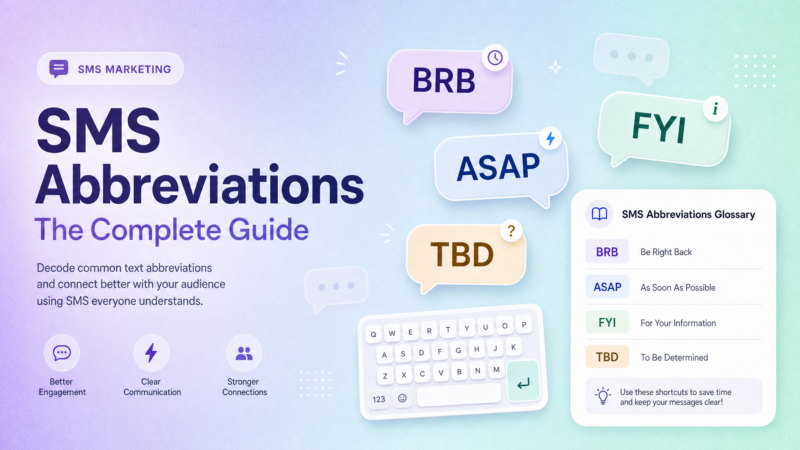
Texting abbreviations are shorthand for words and phrases — LOL for “laughing out loud,” ETA for “estimated time of arrival,” ASAP for “as soon as possible.” They keep texts short and fast, which matters both when you’re typing on a phone and when you’re paying per 160-character SMS segment.
Below is a comprehensive glossary of 150+ abbreviations, grouped by where you’ll actually run into them. At the end, there’s a clear guide to which ones belong in a business text and which ones should stay in your personal group chat.
Bookmark this. Search it. Use it to decode the next message that leaves you guessing.
What Are Texting Abbreviations and Why They Matter {#what-they-are}
Texting abbreviations evolved from the constraints of early mobile phones — 160-character limits and numeric keypads turned brevity into necessity. The term “texting abbreviation” itself is catalogued in reference sources like Webopedia’s technology glossary and Wikipedia’s list of SMS language. Today the keyboard constraint is mostly gone, but the culture of short, fast messaging stuck.
Why they matter for business SMS:
- SMS bills in 160-character segments. Shorter messages keep you in one segment and cost less to send. See Twilio’s SMS documentation for how character encoding affects segment counts.
- Abbreviations signal tone and familiarity — useful when they’re shared, confusing when they’re not.
- In customer-facing text, clarity always beats cleverness. Using an abbreviation a customer doesn’t recognize creates friction right when you want engagement.
The rule is simple: if a stranger might pause to decode it, spell it out. You have 160 characters — use them.
Common Everyday Texting Abbreviations {#common}
These are the ones almost everyone recognizes, from personal texts to casual group chats.
| Abbreviation | Meaning | Example / Notes |
|---|---|---|
| LOL | Laughing out loud | “LOL that’s perfect” |
| LMAO | Laughing my ass off | Stronger than LOL; casual |
| ROFL | Rolling on the floor laughing | Older, still used |
| BRB | Be right back | “BRB, grabbing coffee” |
| BTW | By the way | “BTW, the meeting moved” |
| IDK | I don’t know | “IDK, let me check” |
| IDC | I don’t care | Can read blunt — use carefully |
| IMO / IMHO | In my opinion / in my humble opinion | “IMO the blue one’s better” |
| TBH | To be honest | “TBH I’d skip it” |
| SMH | Shaking my head | Disbelief or disappointment |
| OMG | Oh my god | Surprise or emphasis |
| IKR | I know, right? | Agreement |
| NVM | Never mind | “NVM, found it” |
| TTYL | Talk to you later | Sign-off |
| THX / TY | Thanks / thank you | “THX so much” |
| YW | You’re welcome | Reply to thanks |
| NP | No problem | “NP, happy to help” |
| WYD | What you doing? | Very casual |
| HRU | How are you? | Casual opener |
| JK | Just kidding | Softens a joke |
| FWIW | For what it’s worth | “FWIW, I’d wait” |
| IIRC | If I recall correctly | “IIRC it’s on Friday” |
| AFAIK | As far as I know | Hedges a claim |
| WDYT | What do you think? | “WDYT of this one?” |
| GTG / G2G | Got to go | Sign-off |
| HMU | Hit me up | “HMU when you’re free” |
| ILY | I love you | Personal only |
| OFC | Of course | Agreement |
| RN | Right now | “Can’t talk RN” |
| OTW | On the way | “OTW, 5 min out” |
| ICYMI | In case you missed it | “ICYMI, here’s the recap” |
| TIL | Today I learned | “TIL you can schedule texts” |
| AFK | Away from keyboard | “AFK for a bit” |
| DM | Direct message | “DM me the details” |
| TBA | To be announced | Events, schedules |
| TBD | To be determined | “Date is TBD” |
Reactions, Tone & Emphasis {#reactions}
Short bursts that carry tone more than information — they tell the reader how to feel about the message.
| Abbreviation | Meaning | Example / Notes |
|---|---|---|
| FR | For real | “FR, that was great” |
| NGL | Not gonna lie | “NGL, I’m impressed” |
| ISTG | I swear to God | Strong emphasis |
| LMK | Let me know | Common but vague to strangers |
| WBU / HBU | What about you / how about you | Reply opener |
| SUS | Suspicious | Casual slang |
| FOMO | Fear of missing out | “Big FOMO on that sale” |
| GOAT | Greatest of all time | Praise |
| W / L | Win / loss | “That’s a W” |
| MID | Mediocre | Slang judgment |
| BET | Okay / agreed | “Bet, see you then” |
| IFYKYYK | If you know, you know | Insider reference |
| TFW | That feeling when | Precedes a relatable moment |
| YOLO | You only live once | Older slang, still recognized |
| FTW | For the win | “SMS marketing FTW” |
| SMDH | Shaking my damn head | Stronger version of SMH |
| IRL | In real life | “Let’s meet IRL” |
| TBT | Throwback Thursday | Social media context |
| NSFW | Not safe for work | Content warning |
| POV | Point of view | “POV: you just got a lead” |
| TLDR | Too long, didn’t read | Summary label |
| ETA | Here: also used as emphasis | “ETA on that?” |
Business & Professional Abbreviations {#business}
These show up in work texts, internal team threads, and quick coordination. Most are safe with colleagues. Use judgment before sending to a customer.
| Abbreviation | Meaning | Example / Notes |
|---|---|---|
| FYI | For your information | Customer-safe |
| ASAP | As soon as possible | Customer-safe |
| EOD | End of day | “I’ll send it by EOD” |
| EOW | End of week | Internal more than customer |
| COB | Close of business | Same as EOD in many offices |
| OOO | Out of office | “I’m OOO until Monday” |
| WFH | Work from home | Internal only |
| PTO | Paid time off | Internal |
| ETA | Estimated time of arrival | Customer-safe for deliveries |
| RSVP | Please respond (from French) | Events, invitations — customer-safe |
| AKA | Also known as | Customer-safe |
| DIY | Do it yourself | Customer-safe |
| FAQ | Frequently asked questions | Customer-safe |
| N/A | Not applicable | Forms, replies |
| TIA | Thanks in advance | Polite sign-off |
| NRN | No reply needed | Often missed — spell it out for customers |
| EOM | End of message | Email/subject-line habit |
| WIP | Work in progress | Internal status |
| MTG | Meeting | “Quick mtg at 2?” |
| AGM | Annual general meeting | Formal contexts |
| RE | Regarding / reply | “RE: your question…” |
| CC | Carbon copy | Email context |
| ETA | Estimated time of arrival | Strong customer-safe pick |
| POC | Point of contact | Internal |
| APPT | Appointment | “Your appt is confirmed” |
| 24/7 | All day, every day | “Support 24/7” — customer-safe |
Sales & Marketing Abbreviations {#sales-marketing}
The acronyms you’ll see in marketing dashboards, sales notes, and campaign copy. These belong in team communication, not typically in customer texts.
| Abbreviation | Meaning | Example / Notes |
|---|---|---|
| CTA | Call to action | “Add a clear CTA to the text” |
| ROI | Return on investment | “What’s the ROI on SMS?” |
| KPI | Key performance indicator | Reporting |
| CRM | Customer relationship management | Software category |
| B2B / B2C | Business-to-business / consumer | Audience type |
| BOGO | Buy one, get one | Promo offer — fine in copy if explained |
| SKU | Stock keeping unit | Inventory |
| UGC | User-generated content | Marketing |
| CTR | Click-through rate | SMS/email metric |
| CPC | Cost per click | Ad metric |
| CPL | Cost per lead | Performance metric |
| LTV | Lifetime value | “High-LTV customers” |
| CAC | Customer acquisition cost | Unit economics |
| MQL / SQL | Marketing / sales qualified lead | Pipeline stages |
| AOV | Average order value | E-commerce metric |
| SMB | Small and midsize business | Audience segment |
| SaaS | Software as a service | Product category |
| EOQ | End of quarter | Sales cadence |
| QoQ / YoY | Quarter over quarter / year over year | Growth reporting |
| OPT-IN | Agreed to receive messages | Required for legal SMS |
| DNC | Do not contact | Compliance list |
| 10DLC | 10-digit long code | Business SMS registration system |
| TCPA | Telephone Consumer Protection Act | US compliance law |
| A2P | Application-to-person messaging | Business texting type |
Dates, Times & Logistics {#dates-times}
Shorthand for scheduling and coordination. A few are customer-safe; most read cleaner spelled out in a text to someone you don’t know.
| Abbreviation | Meaning | Example / Notes |
|---|---|---|
| ETA | Estimated time of arrival | “ETA 15 min” — great for deliveries |
| ETD | Estimated time of departure | Logistics, shipping |
| EOD | End of day | Internal more than customer |
| TMRW / TMW | Tomorrow | Casual |
| TGIF | Thank goodness it’s Friday | Casual |
| 24/7 | All day, every day | “Support 24/7” — customer-safe |
| AM / PM | Morning / afternoon | Always spell times clearly |
| MIN / HR | Minute / hour | “Be there in 10 min” |
| APPT | Appointment | Customer-safe |
| DOB | Date of birth | Forms |
| RESV | Reservation | Niche — spell it out |
| CONF | Confirm / confirmation | Spell it out for clarity |
| Q1/Q2/Q3/Q4 | Business quarters | Internal |
| YTD | Year to date | Reporting |
| MTD | Month to date | Reporting |
| ASAP | As soon as possible | Customer-safe |
Which Abbreviations Are Safe in Business Texts? {#safe-for-business}
Most businesses text people who didn’t grow up in the same group chat. The safe list is intentionally short:
Safe with almost anyone:
- FYI, ASAP, ETA, FAQ, RSVP, 24/7, AM/PM, APPT
Fine if your brand is casual (a boutique, a gym, a food truck):
- A light LOL, TY, or a 👍 can warm up a reply. Match your real brand voice.
Skip with strangers:
- LMK, NRN, NGL, TBH, IDK, WFH, EOW — they read as internal shorthand or overly familiar
Professional context, colleagues only:
- CRM, KPI, MQL, SQL, CTR, CAC, LTV — dashboards and internal notes only
The rule: if a stranger would pause to decode it, write the full word. You have 160 characters, and clarity wins more replies than brevity.
Abbreviations to Avoid in Customer SMS {#avoid}
These are common in personal chat and easy to misread in a professional context. Some are rude, some are insider slang, some just look careless from a brand.
| Abbreviation | Why to Skip It |
|---|---|
| WTF, FML, STFU | Profanity — never in customer texts |
| AF, TF, FFS | Crude intensifiers |
| IDGAF | Rude and off-brand |
| LMAO, LMFAO | Too casual for most business contexts |
| SUS, THOT | Slang with ambiguous or inappropriate meanings |
| 4U, GR8, L8R | Numeronyms read as spam or dated |
| U, UR, Y, R | Single-letter swaps look low-effort and can trigger spam filters |
| PLZ, PLS | Spell it out — it’s two extra characters |
| NRN | Most customers don’t know this — spell it out |
Why it matters for deliverability: Carrier spam filters — governed by CTIA Messaging Principles and Best Practices — look for patterns. Single-letter substitutions (u, ur), numeric replacements (4u, gr8), and certain slang patterns are associated with spam and phishing messages. Keeping your texts clean isn’t just about professionalism — it protects your deliverability.
The Business Texting Rule of Thumb {#rule-of-thumb}
The goal of a business text is to be understood in one read, not to sound clever or young. When in doubt: spell it out.
A clean, clear text gets more replies than a cryptic one. Your customers aren’t grading your coolness — they’re deciding whether to respond.
For business SMS, the best approach is saved templates with merge fields like {firstName}. One template lets your team decide once whether to write “appt” or “appointment” — and then every message is consistent, on-brand, and clear. ZeitBlast’s template system with automated drip campaigns does exactly this.
Alt text suggestion: Screenshot of a ZeitBlast template editor showing merge fields and character counter
Start Texting With ZeitBlast
ZeitBlast handles the technical side of business SMS — 10DLC registration, compliance, deliverability — so you can focus on what you write. Saved templates, merge fields, and automated follow-up in one platform.
Request a Demo → zeitblast.com/contact
Related Reading
- 50+ SMS Templates That Get Replies (Copy, Paste, Personalize)
- SMS Marketing Examples: 30+ Templates by Goal & Industry
- What Is SMS Marketing? The Complete Guide
FAQ {#faq}
What does each common text abbreviation mean? The most recognized ones are LOL (laughing out loud), BRB (be right back), TBH (to be honest), IDK (I don’t know), FYI (for your information), ASAP (as soon as possible), and ETA (estimated time of arrival). The tables above cover 150+ grouped by where you’ll actually see them.
Are text abbreviations okay in business texts? A few universal ones are fine — FYI, ASAP, ETA, FAQ, RSVP. Most others are better spelled out. Profanity acronyms (WTF, FML) and single-letter swaps (u, ur, plz) should never appear in customer-facing texts.
What does ICYMI mean? ICYMI means “in case you missed it.” It’s common in newsletters and social media recaps. In a customer text it’s borderline — “just in case you missed this” is clearer and less likely to confuse.
What’s the difference between a texting abbreviation and an acronym? An abbreviation is any shortened form of a word or phrase (appt = appointment). An acronym is formed from the first letters of a phrase and read as its own word or series of letters (ASAP, FAQ). In everyday use, people use both terms interchangeably for “texting shorthand.”
Do abbreviations save money on SMS? A little. SMS is billed in 160-character segments, so a shorter message can stay in one segment and cost less. But clarity matters more — a confusing text that doesn’t get a reply costs you the conversion, which is worth far more than fractions of a cent per segment.
What does NRN mean in a text? NRN stands for “no reply needed.” It’s common in internal work messages. For a customer who’s never seen it, spell it out: “no need to reply” — so they don’t wonder if they missed something.
What does 10DLC mean in SMS? 10DLC stands for “10-digit long code” — the standard business phone number format for A2P (application-to-person) SMS. The 10DLC registration system — managed by The Campaign Registry (TCR) — requires businesses to register their brand and campaign with carriers before sending at volume. The FCC provides guidance on how these rules protect consumers from unwanted messages. It’s the reason your business texts actually get delivered.