
RCS has been “the future of texting” for years. In 2024, something changed: Apple finally added RCS support to iOS 18, which meant that for the first time, the feature worked across Android and iPhone. That’s a real shift — and it has real implications for anyone who texts customers for a living.
But “available” and “universal” are not the same thing in 2026. RCS is live and growing. It’s also still dependent on carrier support, device compatibility, and a business onboarding process that’s newer and less standardized than SMS.
Here’s what RCS is, how it actually compares to SMS and MMS, where adoption stands right now, and what you should realistically expect from it as a business sender.
What Is RCS Messaging?
RCS stands for Rich Communication Services. It’s a carrier-backed messaging standard designed to replace SMS and MMS — not by introducing a new app, but by upgrading the messaging that already lives on your phone.
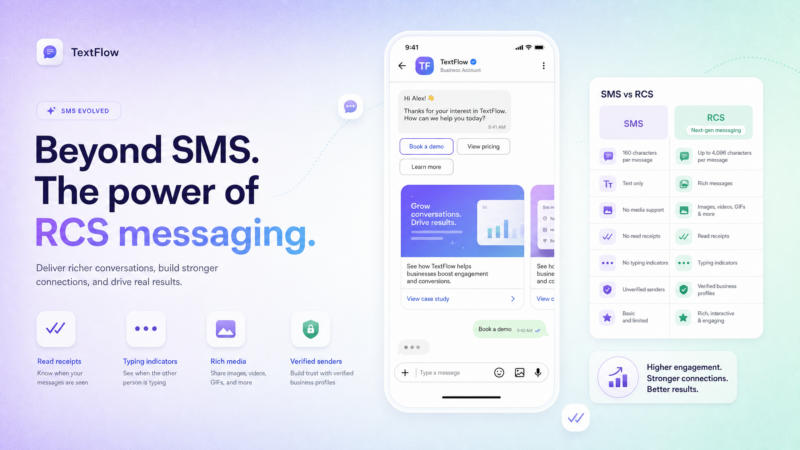
SMS has barely changed since the early 1990s. Texts cap at 160 characters, there’s no read receipt, images arrive compressed and low-resolution, and recipients see nothing but a raw phone number. RCS is designed to fix all of that while keeping texts inside the phone’s built-in messaging app — no download required, no account to create.
On Android, RCS runs in Google Messages. On iPhone, it’s built into the standard Messages app. For the person receiving the message, it looks like a text. It arrives in the same thread, in the same app. The difference is what that message can carry and what it tells the sender.
Key things RCS adds over SMS:
- Read receipts — you know when the message was read, not just delivered
- Typing indicators — the “…” bubble that shows someone is composing a reply
- High-resolution photos and video — not the compressed blurry thumbnails of MMS
- Larger file attachments — audio, documents, and longer video
- Verified business profiles — a sender name, logo, and brand color instead of an unknown number
- Interactive elements — suggested reply buttons, rich product cards, carousels (for business RCS)
- End-to-end encryption — rolling out on supported carrier/OS combinations as of 2026
What RCS does not add: it doesn’t require an app. It doesn’t require Wi-Fi. It doesn’t require a separate login. That’s what distinguishes it from app-based messaging like WhatsApp or iMessage — RCS is a carrier-level standard, same as SMS.
What Is an RCS Message?
An RCS message is a text sent over the Rich Communication Services protocol rather than over the older SMS or MMS protocols. To the recipient, it arrives in their regular Messages app in the normal text thread. The difference is visible: photos are sharp, media is full-resolution, and the sender might appear as a verified brand name rather than a bare phone number.
When RCS is available — both the sender’s carrier and the recipient’s device and carrier all support it — the message routes over RCS automatically. When RCS is not available for a given conversation, the message falls back to SMS or MMS seamlessly. The sender doesn’t have to make a decision. The system downgrades to ensure delivery.
That fallback behavior is one of RCS’s practical strengths. You’re not choosing between reach and richness; you’re getting richness where conditions allow and reach everywhere else.
RCS vs SMS vs MMS: The Differences That Matter
| Feature | SMS | MMS | RCS |
|---|---|---|---|
| Content | Text only | Text + media | Text, media, interactive elements |
| Text limit | 160 chars/segment | Up to 1,600 chars | No hard character cap |
| Media quality | None | Compressed (300–600KB) | High-resolution |
| Read receipts | No | No | Yes |
| Typing indicators | No | No | Yes |
| Business branding | Number only | Number only | Verified name, logo, color |
| Interactive elements | No | No | Reply buttons, cards (via RBM) |
| Encryption | No | No | Rolling out (carrier/OS-dependent) |
| Fallback | Is the fallback | Is the MMS fallback | Falls back to SMS automatically |
| Carrier dependency | Works everywhere | Works nearly everywhere | Requires carrier + device support |
| Business availability | Mature (10DLC) | Mature (10DLC) | Still rolling out (RBM) |
The honest summary: RCS has better features. SMS has better coverage.
SMS reaches every mobile phone on the planet — the newest iPhone, a 15-year-old Nokia, a basic prepaid device in a rural area. RCS reaches every phone whose carrier, OS version, and messaging app all support it. When any of those conditions aren’t met, it becomes SMS anyway.
For businesses, that coverage gap is the operative constraint.
Where RCS Adoption Stands in 2026
Apple and iOS 18
The headline from 2024: Apple added RCS support in iOS 18. This was significant because it meant RCS could finally work in cross-platform conversations — not just Android-to-Android, but Android-to-iPhone and iPhone-to-iPhone when both carriers support it.
Google confirmed: “RCS is now available for texting between Android and iPhones.” Apple describes RCS as “a carrier-provided service” that enables “texts, high resolution photos and videos, links, and more,” along with “delivery receipts, read receipts and typing indicators.” (Apple Support, updated May 2026.)
That’s a genuine milestone. Two years ago, RCS was essentially an Android-only feature. Today it works across the two dominant smartphone ecosystems.
What’s Still Unresolved
Apple added the protocol. That doesn’t mean every iPhone user has it active, or that every carrier has enabled it.
A few things remain unsettled as of mid-2026:
Carrier dependency is real. RCS is a carrier-provided service. Apple explicitly notes it isn’t supported by all carriers or in all countries, and that activating it “can take a few hours after setup.” If your contact’s carrier doesn’t support RCS, the message routes as SMS regardless of what phone they have.
Business RCS (RBM) is still maturing. RCS Business Messaging — the version that adds verified brand profiles, interactive cards, and rich content for business senders — is real but not uniformly available. Onboarding for verified business sending varies by carrier and region, and access isn’t as standardized as SMS’s 10DLC registration process.
Encryption is incomplete. Cross-platform end-to-end encryption for RCS — between iOS and Android — is rolling out in stages and depends on both the OS version and carrier support. It’s not guaranteed to be active for a given conversation.
The practical state in 2026: RCS is genuinely live, genuinely growing, and genuinely better than SMS where it works. But it sits on top of uneven carrier infrastructure, and “most phones support it” is different from “you can rely on it for every contact.”
RCS for Business: What It Offers and What It Doesn’t
The Upside: RCS Business Messaging
For businesses, RCS’s most interesting feature isn’t read receipts — it’s verified sender identity and interactive content.
Verified brand profile. Instead of an unfamiliar 10-digit number, recipients see your business name, logo, and brand color in the message thread. For businesses whose SMS open rates are hurt by unknown-number anxiety, that trust signal is significant.
Rich content. RCS Business Messaging (RBM) supports image carousels, product cards, suggested reply buttons, and appointment cards. These go far beyond what SMS or MMS can deliver — they’re closer to what you’d expect from an in-app notification.
Delivery and read analytics. Unlike SMS, RCS tells you when a message was read — not just delivered. For campaigns, that’s a different category of data.
Interactive replies. Suggested action buttons mean a recipient can tap “Book appointment,” “View listing,” or “Get directions” without typing a single word. Lower friction means higher conversion.
These are meaningful improvements for businesses that currently invest in SMS marketing. The engagement potential of RCS is genuinely higher than SMS for the contacts who have it.
The Limits: Why SMS Is Still the Foundation
The limits of RCS for business are practical, not theoretical:
You can’t reach every contact via RCS. Until carrier support is universal and every phone in your list supports it, SMS fallback is required. That means your business texting infrastructure has to be built for SMS whether you use RCS or not.
Business onboarding is more complex. 10DLC for SMS is a standardized, well-understood registration process. RCS Business Messaging onboarding varies by carrier and aggregator. The process is less predictable, less documented, and takes longer to navigate.
Deliverability is less mature. SMS has decades of carrier relationships, deliverability best practices, and a compliance framework (TCPA, 10DLC) built around it. RCS business sending infrastructure is newer, with fewer established guardrails and less predictable throughput at high volumes.
Costs are less defined. SMS pricing is well-established — carriers and platforms price per segment, and the math is transparent. RCS pricing models are still evolving. For high-volume senders, cost predictability matters enormously.
The practical pattern most businesses end up at: use RCS where it’s available for the richer experience, and build your core infrastructure on SMS — the universal layer that guarantees the message gets through.
RCS vs iMessage vs WhatsApp
It’s worth separating RCS from the other “rich messaging” options people often mention in the same breath.
| RCS | iMessage | ||
|---|---|---|---|
| Requires app | No — native to Messages | No — built into iPhone | Yes — download required |
| Requires account | No | No (uses phone number) | Yes |
| Cross-platform | Yes (Android + iPhone) | iPhone only | Any phone with the app |
| Carrier-based | Yes | No (Apple’s network) | No (internet-based) |
| Business messaging | RBM (rolling out) | Apple Business Chat | WhatsApp Business API |
| Fallback to SMS | Yes, automatic | No — sends as SMS manually | No — message not delivered |
| Reach | Near-universal (with fallback) | iPhone users only | Users with the app installed |
iMessage is Apple-only. If you’re not on an iPhone, you can’t receive it natively — you get a green bubble SMS instead. WhatsApp requires an account and an app install, which means you’re messaging only the subset of your contacts who’ve opted into that ecosystem.
RCS is the only option that reaches across ecosystems, runs in the native messaging app, and falls back to SMS when unavailable. That architecture makes it the most viable candidate for universal rich messaging — eventually. But it’s still the “eventually” that’s doing a lot of work in 2026.
What RCS Means for Business Texting Today
If you’re building a business texting program right now — for real estate prospecting, sales follow-up, lead generation, or customer communication — here’s the grounded read:
SMS is still the workhorse. It reaches everyone. The business framework around it — 10DLC registration, consent, opt-out handling — is mature and well understood. For reliable, compliant, high-deliverability business messaging in 2026, SMS is the foundation.
RCS is worth understanding, not waiting for. The technology is real. The Apple adoption opened a meaningful door. But the infrastructure for business RCS — carrier relationships, onboarding, compliance, pricing — isn’t where SMS’s 10DLC ecosystem is. Businesses building their texting strategy around RCS availability are making a bet on infrastructure that’s still maturing.
The fundamentals don’t change. Whether you’re sending over SMS or RCS, the rules are the same: get written consent, identify yourself clearly, provide an easy opt-out, honor it immediately, and respect quiet hours. Those rules apply across message types because they’re about the relationship, not the protocol.
RCS will matter more in 2027, 2028, 2029. Carrier rollout will continue. RBM will mature. The gap between SMS reach and RCS reach will narrow. When that happens, businesses already running high-performance SMS programs will be well-positioned to layer RCS on top. Businesses still figuring out the basics will be further behind.
Build your program on SMS today. Watch RCS closely. Add it when the infrastructure supports your volume and your compliance needs.
How ZeitBlast Fits Into This Picture
ZeitBlast is an SMS platform. We don’t offer RCS — we focus on doing SMS right, at the volumes real estate professionals and sales teams actually send, with the compliance infrastructure and deliverability those volumes demand.
We cover RCS in this guide because it’s a question that comes up constantly: “Should I be using RCS? Am I missing out?”
The honest answer: for reaching every customer reliably and compliantly today, SMS remains the right foundation. And ZeitBlast is built to make that foundation as strong as possible:
- 98% deliverability rate — built on direct carrier relationships and carrier-safe batching
- 10DLC approval in as little as 48 hours — the fastest in the industry
- Unlimited inbound and reply messages — always free, because engagement shouldn’t cost extra
- AI Conversation Agent — handles replies automatically, qualifies leads, and routes conversations so your team works only the hot ones
- Built-in DNC and litigator scrubbing — protect yourself from legal exposure before a single message goes out
- Credit rollover — unused texts carry forward so you’re never throwing away budget
When business RCS infrastructure matures to the point where it makes sense to integrate — reliable carrier availability, standardized onboarding, predictable pricing, mature deliverability tooling — ZeitBlast will evaluate it seriously. Until then, we’re focused on making SMS work as well as possible, because that’s where your contacts actually are today.
ZeitBlast plans start at 495/month∗∗(I′mSeriousplan,15,000credits),scalingto∗∗495/month∗∗(I′mSeriousplan,15,000credits),scalingto∗∗795/month (Time to Scale, 30,000 credits) and $1,495/month (Market Dominator, 65,000 credits). All plans include 10DLC approval, live support, credit rollover, and a premium local sending number.
Frequently Asked Questions
What is RCS messaging? RCS (Rich Communication Services) is a carrier-backed messaging standard that upgrades SMS and MMS with modern features: read receipts, typing indicators, high-resolution media, and verified business profiles — all inside the phone’s native messaging app. No app download or account required.
Is RCS better than SMS? It depends on what you mean by better. In terms of features — receipts, rich media, branding, interactivity — RCS is more capable. In terms of reach and reliability, SMS still wins. SMS works on every phone, every carrier, worldwide. RCS requires device, carrier, and OS support, and falls back to SMS when any of those isn’t in place.
Does RCS work on iPhone? Yes, as of iOS 18 (released 2024). Apple added RCS support so that RCS messaging works between iPhones and Android phones. It’s a carrier-provided feature, though — so it’s only active when your carrier supports it. Apple notes activation can take a few hours and isn’t available on all carriers or in all countries.
What’s the difference between RCS and iMessage? iMessage is Apple’s proprietary system that works only between Apple devices. RCS is a carrier-level standard that works across Android and iPhone. Both offer rich features, but RCS has broader cross-platform reach and falls back to SMS when unavailable. iMessage falls back to SMS as a plain green-bubble text, with no automatic detection.
Can businesses send RCS messages? Yes, through RCS Business Messaging (RBM), which enables verified business profiles, interactive cards, and rich content. It’s still rolling out in 2026 — availability varies by carrier and region, and onboarding is more complex than SMS’s 10DLC process. Most businesses pair RCS with SMS to ensure full list coverage.
What does RCS mean for my SMS marketing program? It means SMS remains your reliable foundation today while RCS is an emerging layer to watch. The core compliance requirements — written consent, opt-out handling, carrier registration — apply to both. For now, investing in a strong SMS program positions you well to add RCS when infrastructure matures.
Does ZeitBlast support RCS? ZeitBlast is an SMS platform focused on high-deliverability, compliant business texting. We don’t currently offer RCS. For businesses that need to reach their entire contact list reliably today, SMS through ZeitBlast is the right foundation.
See What ZeitBlast Can Do for Your SMS Program
RCS is the future of messaging. SMS is the present — the reliable, compliant, universally accessible foundation every business texting program should be built on today.
ZeitBlast gives you that foundation with 98% deliverability, 48-hour 10DLC approval, built-in compliance protection, and AI-powered reply handling that turns your campaigns into real conversations.
Request a demo at zeitblast.com/contact and see why real estate teams and sales organizations trust ZeitBlast for their most important outreach.
Related reading:
- What Is SMS Marketing? — the complete primer on business texting at scale
- What Is 10DLC? — the carrier registration that makes your SMS deliverable
- TCPA Compliance — the consent rules that apply to SMS and RCS alike
- SMS vs MMS — the two message types that form today’s business texting foundation
- Group Text vs Mass Text — why group texts don’t work for business outreach