
What is an SMS blast?
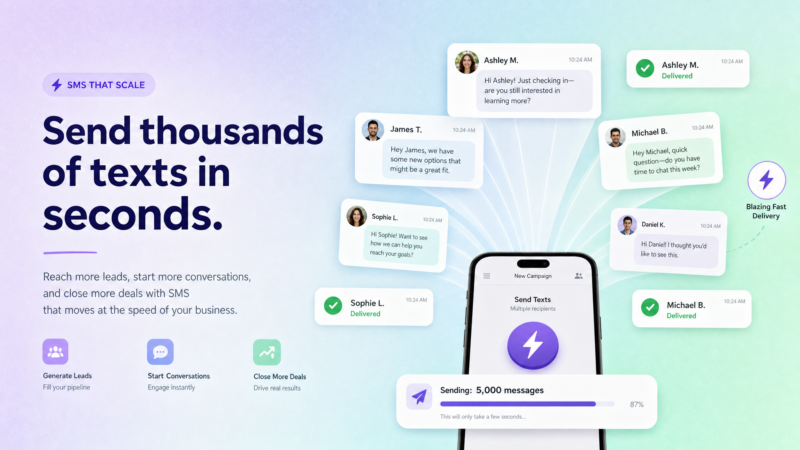
An SMS blast — sometimes called a text blast or mass text — is a single message delivered to a large list of contacts simultaneously. Instead of texting people one at a time, you write one message and push it to hundreds or thousands of opted-in recipients at once.
It sounds simple, and the concept is. But execution determines whether it lands in someone’s inbox and drives action, or gets filtered by a carrier before it reaches anyone.
A few things define what a blast actually is:
One message, many recipients. The same core content goes to your entire list or a defined segment of it — typically personalized with merge fields like a first name so each message feels direct.
Speed at scale. This is the defining advantage. 90% of text messages are read within three minutes of delivery, and 74% of consumers check a text notification within five minutes (SimpleTexting, 2026). No other channel moves information through a list that fast.
Requires the right infrastructure. Sending thousands of texts from a personal phone gets you blocked. Blasts require a registered business number, a compliant platform, and carrier-approved sending rates. ZeitBlast’s carrier-safe batching ensures messages go out at rates carriers approve — which protects your deliverability over time.
For the broader context on how SMS marketing works, see our SMS marketing guide.
SMS blast vs. one-to-one texting
| SMS Blast | One-to-One Texting | |
|---|---|---|
| Audience | Entire list or segment | Individual contact |
| Best for | Announcements, promotions, alerts | Follow-up, sales conversations, support |
| Tone | Broadcast (with personalization) | Conversational |
| Volume | High — hundreds to thousands at once | Low — individual exchanges |
| Compliance | Same rules, higher stakes | Same rules, lower volume |
Most high-performing SMS programs use both. A blast is the first move — the announcement that reaches everyone at once. The replies it generates become one-to-one conversations where the actual deal gets closed.
When an SMS blast is the right move
A blast works best when timing and reach matter more than dialogue. Common use cases:
Sales and promotions
Flash sales, limited-time offers, new product drops, coupon codes. An SMS blast is the fastest way to get a time-sensitive offer in front of your entire audience before it expires.
New listing and inventory alerts
For real estate teams, a blast pushes a new listing to your buyer list the moment it hits the market. For wholesalers, it’s the fastest way to move inventory to cash buyers. Speed is competitive advantage — the deals go to whoever responds first.
Event announcements and reminders
Invitations, event-day logistics, last-minute changes. A blast ensures no one misses the message by burying it in an inbox.
Re-engagement campaigns
A list that’s gone quiet isn’t dead — it’s waiting for a reason to re-engage. A well-timed blast with a compelling hook can reactivate contacts that email hasn’t reached in months.
Appointment reminders
For service businesses, an automated reminder blast reduces no-shows dramatically. Studies across 16,000+ patients showed text reminders cut no-show rates by 25% (BMJ Open, 2016) — numbers that hold up in any service category.
Operational alerts
Closures, schedule changes, outage notices, urgent updates. When the information is time-critical, a blast guarantees it reaches people fast.
If your goal is a real conversation — a sales follow-up, a support issue — a blast is the opener. Build the conversation infrastructure before you hit send.
Compliance: what you must get right before you send
This is the part that separates senders who stay deliverable from those who get blocked. An SMS blast must satisfy both TCPA regulations and carrier requirements. Miss these and your blast doesn’t land — it gets filtered.
Only text people who opted in
This is the foundation. Before anyone receives your blast, they must have expressly consented to receive marketing messages from your business. A checkbox at sign-up, a keyword opt-in, or a documented verbal consent all work. A purchased list does not — blasting contacts who never consented is the fastest route to FCC complaints, carrier blocks, and legal exposure.
For a full breakdown of consent requirements, see our TCPA compliance guide.
Register your 10DLC campaign
Carriers require business text senders to register their brand and campaign through the 10DLC system — administered by The Campaign Registry (TCR) — before sending at volume. Unregistered traffic gets filtered. Registration is what establishes your legitimacy with carriers — it’s not optional for anyone serious about deliverability.
ZeitBlast completes 10DLC registration in as little as 48 hours.
Include identification and an opt-out in every message
Every blast needs to identify your business and include an opt-out mechanism (“Reply STOP to unsubscribe”). This is required under CTIA Messaging Principles and Best Practices and federal law. Opt-outs must be processed immediately and permanently — no exceptions, no delays.
Respect quiet hours
Don’t send before 8 a.m. or after 9 p.m. in each recipient’s local time zone. Some state laws are stricter. A good platform enforces this automatically — you should never have to think about it.
ZeitBlast includes unlimited DNC and litigator scrubbing on every plan, automatic opt-out processing, and quiet-hours enforcement built in.
How to send an SMS blast (step by step)
Step 1: Choose a compliant platform and register your 10DLC
Your platform handles the infrastructure: carrier registration, opt-out processing, message routing, analytics. Choose one with compliance built in so you’re not manually managing legal requirements. If you haven’t registered your 10DLC campaign yet, that comes first.
Step 2: Build a clean, opted-in list
Import contacts who have expressly consented to receive texts from your business. Scrub for duplicates, invalid numbers, and any contacts who have previously opted out. Starting with a dirty list guarantees poor results and compliance risk.
ZeitBlast’s unlimited DNC and litigator scrubbing runs automatically — your list stays clean without manual work.
Step 3: Segment if it improves relevance
A targeted blast to 500 well-matched contacts almost always outperforms a generic blast to 5,000. Segment by location, funnel stage, buyer profile, or interest when it makes the message more relevant. Relevant messages get replied to. Generic messages get opted out of.
Step 4: Write one tight message
An effective SMS blast hits all of these:
- Identifies your business — say who you are upfront
- Delivers the value immediately — don’t bury the lead
- Has one clear call to action — one link, one keyword, one ask
- Stays near 160 characters — anything longer splits into multiple segments and costs more
- Includes an opt-out line — required, and kept short (“Reply STOP to opt out”)
Avoid emoji-heavy messages if budget matters — emoji characters force Unicode encoding and can split a single message into three segments.
Step 5: Personalize with merge fields
A blast that opens with the recipient’s first name performs measurably better than one that doesn’t. Most platforms support merge fields — use them. The effort is minimal; the response lift is real.
Step 6: Test before you send
Send the message to yourself and at least one teammate. Check:
- Does every link work?
- Does the opt-out line render correctly?
- Does the message identify your business?
- Is there a character count issue splitting it into multiple segments?
A blast you can’t take back. Testing takes two minutes.
Step 7: Schedule for the right moment
Send inside quiet hours (8 a.m.–9 p.m. in the recipient’s time zone). Beyond compliance, timing affects results — mid-morning and early afternoon typically see strong engagement. Avoid Mondays and early mornings when inboxes are already full.
Step 8: Prepare for replies
This step is where most teams leave money on the table. A blast that generates interest but routes replies into an unmonitored inbox converts nothing. Have a plan before you send:
- Route replies to a shared inbox where your team can respond
- Set up automated keyword responses for common replies
- Use ZeitBlast’s AI Conversation Agent to handle initial responses and qualification automatically
Step 9: Measure and iterate
After every blast, review: delivery rate, reply rate, click-through rate, opt-out rate. ZeitBlast’s real-time analytics dashboard shows campaign performance as it happens. The metrics tell you what to adjust — subject, timing, frequency, audience — on the next send.
What separates a blast that converts from one that doesn’t
The mechanics are the same for every sender. What separates results is message quality and follow-through.
One idea, one ask. Recipients who receive a message with multiple links, multiple offers, or multiple questions don’t act on any of them. Pick one.
Lead with value, not your logo. The first thing a recipient reads determines whether they engage or ignore. What’s in it for them should be the first sentence.
Create urgency that’s real. “Limited time” only works if there’s an actual limit. A specific deadline (“ends Friday at noon”) or a quantity constraint (“first 20 responses”) gives people a real reason to act now.
Make the next step frictionless. One link, one keyword reply, one phone number. Anything that requires effort kills response rates.
Frequency kills more lists than bad copy. The top reason consumers opt out of business texts is receiving them too often (SimpleTexting, 2026). Match frequency to what your list signed up for.
What happens after you hit send
A blast doesn’t end when it sends. It ends when you’ve worked every reply.
The replies a blast generates are conversations in early stages. Someone responded because they’re interested — the job now is to move that interest toward action. That means:
- Routing replies to the right person or queue
- Responding fast (the average text reply time is 90 seconds — your competitors are also texting)
- Having a follow-up sequence ready for contacts who don’t reply immediately
ZeitBlast’s AI Conversation Agent handles this layer automatically. It responds to incoming messages, qualifies leads based on your rules, and routes hot conversations to your team — without a VA or an extra headcount.
For a deeper look at automated follow-up strategies, see our guide to SMS drip campaigns.
How ZeitBlast handles blasts
ZeitBlast is built for operators sending real volume who need every message to land. Here’s what’s under the hood:
Carrier-safe batching. Messages go out at carrier-approved rates — which protects your number reputation and long-term deliverability. No throttling surprises, no sudden carrier blocks.
98% deliverability rate. Direct carrier relationships and a clean sending infrastructure keep your messages out of the filter queue.
Built-in compliance. DNC scrubbing, litigator scrubbing, automatic opt-out processing, and quiet-hours enforcement run on every campaign — you don’t manage them manually.
Blast + two-way in one platform. Send to your entire list, then handle every reply in a shared conversations inbox. The full cycle — broadcast, engage, convert — happens in one place.
Real-time analytics. Monitor delivery, response, and opt-out rates as the campaign runs. Catch issues early and adjust without waiting for a post-campaign report.
Plans built for volume:
| Plan | Monthly Price | Texts Included |
|---|---|---|
| I’m Serious | $495/mo | 15,000 |
| Time to Scale | $795/mo | 30,000 |
| Market Dominator | $1,495/mo | 65,000 |
All plans include credit rollover, unlimited incoming messages, live support, and optional AI Conversation Agent access.
Frequently asked questions
What is an SMS blast? A single text message sent simultaneously to a large list of opted-in contacts — used for promotions, alerts, announcements, and re-engagement. It’s one-to-many, typically personalized, and sent from a registered business number.
Is sending an SMS blast legal? Yes, with the right setup. Under the Telephone Consumer Protection Act (TCPA), you need express opt-in consent from every recipient, a registered 10DLC campaign, identification in the message, an opt-out mechanism, and compliance with quiet hours. Miss any of these and you’re exposed. See our TCPA compliance guide for the full picture.
How many people can I send an SMS blast to? As many as your list contains, within your plan’s message limits. ZeitBlast plans range from 15,000 to 65,000 messages per month, with enterprise high-throughput accounts available for higher-volume senders.
Can people reply to an SMS blast? Yes — and they should. On ZeitBlast, replies route to a shared conversations inbox where your team (or the AI Conversation Agent) continues the conversation. Replies are always free and unlimited.
How do I know if my blast worked? Track delivery rate (were messages received?), reply rate (did people engage?), click-through rate (if you included a link), and opt-out rate (frequency or relevance issue?). ZeitBlast’s real-time analytics dashboard shows all of this live.
What’s the difference between a blast and a drip campaign? A blast is a one-time send to a list. A drip campaign is a sequence of automated messages sent over time — triggered by enrollment or behavior. Most strong SMS programs use blasts to generate initial engagement and drip campaigns to follow up systematically.
Start sending blasts that convert
ZeitBlast gives you the infrastructure to send compliant, high-deliverability SMS blasts — and the tools to turn every reply into a real conversation. 10DLC approval in 48 hours, carrier-safe sending, real-time analytics, and an AI that handles replies while your team sleeps.