
What SMS marketing actually is
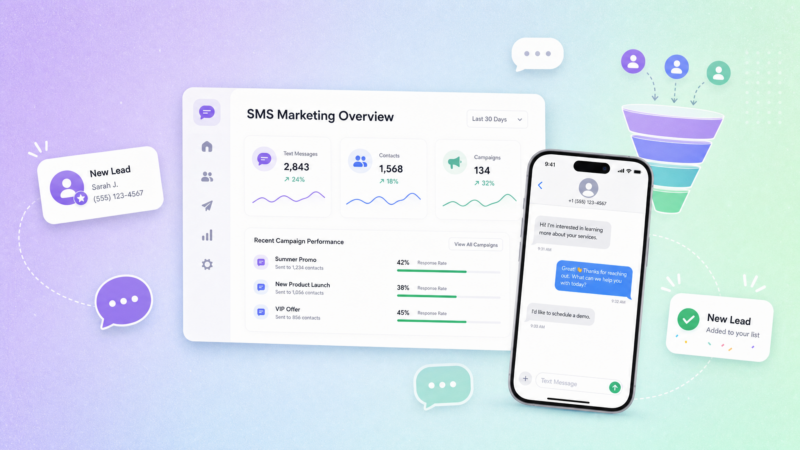
SMS marketing is the practice of sending short, permission-based text messages to contacts who have opted in — to drive leads, promote offers, confirm appointments, or follow up on open conversations. It runs on the same messaging infrastructure your phone uses every day, delivered through registered business numbers built to handle volume.
The key word is permission. SMS marketing is not cold texting a purchased list. It’s communicating with people who raised their hand and said, “Yes, text me.” That consent requirement is what separates legitimate business texting from spam — and it’s also what makes the channel perform the way it does.
If you’re new to the terminology, it’s worth understanding the distinction between SMS and MMS before you dive in — the two formats have different costs and different use cases.
How it works under the hood
When a business sends an SMS marketing campaign, a few technical layers make it possible:
1. A registered business number Businesses don’t text from personal phones. They use a dedicated number — typically a 10-digit local code (10DLC) — registered with carriers through a system called Application-to-Person (A2P) messaging. This registration tells carriers who you are, what you’re sending, and why. Without it, your messages get filtered before they reach anyone.
2. A messaging platform The platform is where you manage your list, compose messages, schedule campaigns, and measure results. A good platform handles compliance automatically — DNC scrubbing, opt-out processing, quiet-hours enforcement — so you’re not tracking those things manually.
3. Carrier routing Your messages travel through carrier networks (AT&T, Verizon, T-Mobile, etc.) to reach recipients. Carriers actively filter traffic that looks like spam — guided by CTIA Messaging Principles and Best Practices — which is why registration and compliant sending practices matter for deliverability — not just legal compliance.
4. Opt-in and opt-out management When someone texts a keyword to opt in, or checks a box at signup, that consent record is logged. When they reply STOP, that opt-out is processed immediately and permanently. The whole system runs in the background on a well-built platform.
ZeitBlast manages all of this — including 10DLC approval in as little as 48 hours, which is among the fastest in the industry.
Why businesses use SMS marketing
The short answer: people read their texts. 97% of Americans now own a cellphone of some kind (Pew Research Center, 2024), making SMS one of the few channels with near-universal reach.
SMS open rates run as high as 98%, according to an FCC Consumer Advisory Committee report. Compare that to a ~35.6% average email open rate (Mailchimp, 2023), and the attention gap is hard to ignore. More importantly, 74% of consumers check a text notification within five minutes of receiving it (SimpleTexting, 2026).
For businesses where timing is everything — a real estate team following up on a showing request, a sales team responding to an inbound inquiry, a service business confirming an appointment — that immediacy changes the economics of lead response entirely.
Beyond open rates, SMS delivers response rates that email can’t match. Industry benchmarks put SMS response rates as high as 45% (FCC CAC, 2022), versus 6% for email from the same source. That gap is why teams that shift lead follow-up to text see more conversations started, more appointments set, and more deals closed.
Types of SMS marketing messages
Not every business text looks the same. The three main categories:
Promotional messages
Sales announcements, limited-time offers, new listing alerts, coupon codes, and anything designed to generate immediate action. These are the most common, and the most regulated — they require express opt-in consent.
Transactional messages
Appointment confirmations, scheduling reminders, order updates, and other informational messages tied to a specific transaction or relationship the contact already has with your business. Still subject to compliance rules, but often permitted with a softer form of consent.
Conversational messages
Two-way follow-up with leads and customers — real dialogue that starts with a broadcast and turns into a qualified conversation. This is where SMS marketing creates the most direct revenue impact, especially for sales-driven teams.
Most sophisticated SMS programs use all three. Start with a broadcast (promotional), automate the follow-up (transactional), and route hot replies into real conversations.
The compliance rules you need to know
U.S. business texting operates under two primary frameworks: the TCPA (Telephone Consumer Protection Act) and the 10DLC carrier registration system. You don’t need to be a lawyer to run a compliant program, but you do need to understand these four fundamentals:
1. Get consent before you text
Express written consent is required for marketing messages. A checkbox at sign-up, a web form, or a keyword opt-in all work. A purchased list does not — texting people who didn’t ask to hear from you exposes you to serious legal and carrier risk.
For a full breakdown, see our guide to TCPA compliance.
2. Identify your business in every message
Recipients need to know who’s texting them. Identify yourself — at minimum, include your business name or a recognizable sender ID in the message.
3. Honor opt-outs immediately
“Reply STOP to opt out” must work, and it must work permanently. Any platform worth using processes opt-outs automatically.
4. Respect quiet hours
Don’t text before 8 a.m. or after 9 p.m. in the recipient’s local time zone. Some states have stricter rules. A good platform enforces quiet hours automatically.
5. Register your 10DLC campaign
This is the carrier side of compliance. Before you can send bulk business texts, you register your brand and campaign through the 10DLC system with The Campaign Registry (TCR). It’s what gets your messages delivered instead of filtered. ZeitBlast guides you through this process and completes registration in as little as 48 hours.
ZeitBlast also includes unlimited DNC (Do Not Call) and litigator scrubbing on every plan — automated protection that keeps your list clean and your exposure minimal.
What SMS marketing costs in 2026
SMS marketing pricing typically has two components: a platform subscription and per-message costs. What you pay depends on your volume and the platform you use.
ZeitBlast pricing
ZeitBlast bundles everything — compliance tools, AI conversation features, real-time analytics, CRM integrations, and live support — into straightforward plan tiers:
| Plan | Monthly Price | Texts Included | Best For |
|---|---|---|---|
| I’m Serious | $495/mo | 15,000 texts | Solo operators |
| Time to Scale | $795/mo | 30,000 texts | Growing teams |
| Market Dominator | $1,495/mo | 65,000 texts | Multi-market operations |
All plans include:
- Unlimited incoming and reply messages (always free)
- Credit rollover — unused texts carry forward
- 10DLC approval in as little as 48 hours
- Live phone, chat, and email support
- Premium local sending number
- Optional AI Conversation Agent
- Cancel anytime
For businesses doing real volume, the math is straightforward: compare the cost of the platform against the value of the leads it generates. A single closed deal from a SMS follow-up sequence more than covers the monthly fee.
The hidden cost: setup time
The real cost most people underestimate isn’t money — it’s time. Getting 10DLC registered, building your opt-in flow, writing your message sequences, and connecting your CRM all take setup work. Platforms that guide you through this (and support you when something breaks) shorten that timeline significantly.
How to get started with SMS marketing
Here’s the practical sequence:
Step 1: Choose a platform that handles compliance Trying to run SMS marketing from a personal phone or a spreadsheet is a compliance disaster in slow motion. Use a platform that manages 10DLC registration, opt-out processing, and carrier-safe sending automatically.
Step 2: Register your brand and campaign Through your platform, register your business with carriers via the 10DLC system. This is what gets your messages delivered. ZeitBlast completes this in as little as 48 hours.
Step 3: Build your opt-in flow You need a way to collect consent. Options include:
- A checkbox on your website or lead form
- A keyword opt-in (“Text START to 555-0100”)
- A verbal opt-in captured and logged at point of sale
Be explicit about what people are signing up for.
Step 4: Segment your list Even a small, well-segmented list outperforms a massive generic one. Group contacts by where they are in your funnel, what they’re interested in, or what action you want them to take.
Step 5: Write messages that earn a response Keep it short. Identify yourself. Deliver one clear value proposition or ask. Include a call to action. Skip the filler.
Step 6: Automate your follow-up The money is in the sequence, not the single blast. Set up drip campaigns that follow up automatically based on time elapsed or contact behavior. ZeitBlast’s AI Conversation Agent can handle replies, qualify leads, and route conversations — without a VA.
Step 7: Measure and improve Track delivery rates, response rates, opt-out rates, and conversion metrics. ZeitBlast’s real-time analytics dashboard shows you what’s working. Adjust your messaging, timing, and frequency based on what the data tells you.
Who SMS marketing works for
SMS marketing isn’t niche. Any business that generates leads, books appointments, or needs to reach people fast is a candidate.
Real estate: New listing alerts, open house reminders, follow-up with buyers who went silent. Text converts cold leads to live conversations faster than any other channel.
Sales teams: Outbound prospecting, follow-up sequences for inbound leads, appointment confirmation, pipeline reactivation. For more, see our guide to SMS marketing for sales teams.
Service businesses: Appointment reminders cut no-shows dramatically. Confirmation sequences run automatically. Follow-up after service keeps the relationship warm.
Recruiters: Candidate outreach, interview scheduling, pipeline management. Companies using SMS in recruiting fill positions twice as fast as those relying on email alone (Aptitude Research, 2022).
Marketers running campaigns: Promotions, event announcements, flash sales, re-engagement sequences for dormant contacts.
The common thread: if your business depends on timely conversations, SMS marketing is the fastest way to start them.
Frequently asked questions
Is SMS marketing legal? Yes, with consent. The TCPA doesn’t prohibit business texting — it requires express permission, clear identification, and an easy opt-out. Follow those rules and you’re operating legally.
What’s the difference between SMS and MMS? SMS is text-only, capped at 160 characters per segment. MMS adds images, audio, or video and costs more per message. See our full breakdown in SMS vs. MMS.
Do I need a website to start? No. You need a documented opt-in — and many platforms, including ZeitBlast, can generate a compliant opt-in landing page for you.
How is SMS marketing different from email marketing? Texts are shorter, read dramatically faster, and held to stricter consent rules. SMS is built for time-sensitive outreach — lead follow-up, appointment reminders, urgent offers. Email is better for longer-form content and nurture sequences that don’t depend on immediate response.
What’s 10DLC and do I need it? Yes. 10DLC (10-digit long code) is the carrier registration system every business must use for bulk A2P texting in the U.S. Without it, your messages get filtered. ZeitBlast handles registration for you. Full explanation in our 10DLC guide.
Start texting with ZeitBlast
ZeitBlast is built for operators who need SMS to generate real results — leads that reply, appointments that show, pipelines that move. With 48-hour 10DLC approval, built-in compliance tools, an AI Conversation Agent, and a 98% deliverability rate, it’s the platform for teams that take their outreach seriously.